Showing posts with label Inspiration. Show all posts

Thursday, July 17, 2014

Some things


An old map of Trento in exhibition at MART in Rovereto. Great exhibition.


Painted walls in Trento


Drawing: insomnia sucks.

Drawing: I'm fighting some inner monsters.

Drawing: Dreamy mountains
 I babysit to make ends meet. Me and the 7 year old boy I look after made these colourful prints from folded paper boats coloured in with felt pens. 


Saturday, November 9, 2013

Moments and things.


I try to do a weekly drawing/ moment which I post on Instagram and Facebook.
The sea spew out everything. 

There are moments when it is hard to focus on work and one needs to be pulled back to earth.

Chocolate slogan cake


Inspiration: detail of Mountains by Matteo Rubbi


Autumn


Wednesday, August 7, 2013

Sunday, November 25, 2012

Projects that inspire me: South Africa you rock!!!

My research is taking me to such good places! Can't wait to visit home! The discovery of projects that goes beyond what I could possibly imagine, makes me feel like an inadequate and lazy artist. While I'v been indulging in what it means to make art for myself, these artists and curators were moving comfort zones and doing things. I would like to mention some of these amazing people and projects here, because they are really inspiring me to do something. Look at the Keleketla!Library project, The Centre for Historical Re-enactments, Assemblage Studios, Cuss collective and Gugulective


If anything the arts in SA at the moment shows that we are in transformation, young artists and curators looking for new languages to express this identity that we are seeking and to respond to the conditions that South Africans live in. It is clear that art is reviving the public realm, that it is looking towards the community and no longer looking to hang on the walls in Mooikloof and Sandton.


I like what Rangoato Hlasane one of  the creators of Keleketla! is saying here in Liberator magazine:
“I have no intentions of spending time in [an] isolated studio making images for galleries as a devotion or career... I really do feel that art for walls is sometimes overrated. I feel that it creates disillusions [sic]. I make art, and I find value in the process; it is a method for my sanity, my reflection on things and a chance to imagine a different world. I hope that my work does that, enables... contemplation on things.”
 "The general society knows very little about art and the art that is being created with assumptions of changing the world. We have an inherent self-importance. It's unhealthy, makes us defensive, inflates egos and brings us all down when it all falls down. There can only be a few art superstars. This may sound like sour grapes and it would be if I wasn't doing well with my work, but I am. I just don’t have any illusions and consider it a waste of time to lock myself in a studio only to spend my life drinking wines and distressing over capitalist gallerists. My point is that art processes, rather than outcomes, have the potential for impact". 

Monday, October 29, 2012

Photo board


Autumn - my favourite season, even though Milan is not exactly the most spectacular Autumn tree city (in fact Milan needs more trees), the parks are still really beautiful. Took this picture in Indro Montanelli park in corso Venezia. 


Lack of space on my hard drive forced me to clean up my computer and I discovered this photo. 
"I DONT CARE" - In the cold.
To become a photographic print.

The lonely office chair and backpack.
In the winter the Navigli gets drained, this is the crap that it reveals. 

INFINITE


An update and some reads.


Mainly I am just reading and searching and reading and searching and reading for my thesis at the moment which feels like a disaster and like I never know enough, but I am hoping that it is just the normal process of the thing, and that, that is in fact how you learn a lot. The problem is mainly that I end up getting lost and reading to wide or I get of topic. Focus!!!!

Then on other news, my three quilts "Progress and development" from Isola project is on auction at Galleria Bianconi, (also along some of my friends such as Edith Poirier and Cherimus) to raise funding for the book of Isola Art Centre.


Then some reading:

Some great books I got (some on ebook, some actual ones - but considering that I will have to move these back to SA soon, I am trying to supress my need for actuall paper pages):
Art and the end of Apartheid by John Peffer (reading it right now, very easy to read, not stiff and elitist academic - I think a must  for anyone interested in South African art history).
Documenta 13/ The Book of Books (damn expensive but was lucky to get a discount). So far I've only looked at the pictures, read the introduction and  the one On the  Destruction of art, and then had to remind myself that in fact  I should focus on reading for my thesis.

Also if you are interested in urban theory and cities from a non Western perspective please go check out the  African Cities Reader which is an online journal with contributions covering a wider range of topics covering African cities and its diversity. 


Tuesday, July 3, 2012

Internet tools and Arte Povera


Things such as Pinterest has a way of completely absorbing your time. One can spent hours getting lost in this form of visual consumption (something one must at least be critical of). Nevertheless it can be an incredibly helpful tool for students and artists to organise visual research. I prepared this Arte Povera  board while studying for an exam about it, which in the end helped me so much in being able to summarise some important works by some of the most important artists of the movement. Having images in my head as reference helped a lot  to recall the information. And the best thing was that I could just peek at this before I went to do the exam which was a quick and efficient way to refresh my memory.

By the way how wonderful is Arte Povera? Af first I was annoyed by the fact that we had an entire module just based on Arte Povera, but after this exam, I am so blown away by it. There is something timeless in these works. I especially love the work of Giovanni Anselmo. Such poetry in the way he used opposite materials together, played with gravity and tension, always keeping one in suspense of something that is about to happen. He is going on to my favourite artist list. 

Sunday, June 17, 2012

The artist is like a dog

“An old west African proverb compares the artist to a dog. Positioned at the interface of the
human and the natural worlds, the dog in most ancient African societies enjoyed slippery and
highly ambiguous cultural status.
 
Neither a human being, nor a wild animal, it was nevertheless admitted in the domestic
sphere where it was recognised as man's best friend.
Loyal to a fault, it was committed to its master to the point of helping him hunt wild animals.
This is why it enjoyed special rights.
Because a dog was never happier than when its nose was up another's rear end- the anus,
that sensory button of the world - it also symbolised debasement and degradation.
Just like the dog, the artist also enjoyed special rights, including the right to conduct
forbidden experiments. His task was to translate society to itself”. – Achille Mbembe, Cape
Times, June 5 2012

Monday, April 23, 2012

Curators in South Africa

Even though the making of exhibitions has been taking place in South Africa and the world since way back curatorship as we know it today and as a field of study  has only  been making its way in South Africa in the recent years. However the challenges there seems to be curators on the rise who do amazing work. Found this article in the Mail&Guardian on 6 curators working in South Africa.  Here is a few quotes that struck me as interesting reflections on images, curatorship also reflecting specifically in a Southern African context.


Perhaps because of the digital age in which we live, people have become desensitised to an image unless it is “hypersensational”.  Thato Mogotsi
The curator's role, she says, "should be more about mediation, which some artists are resistant to, but also about facilitating access to work and getting a deep understanding of the works and artists who make them — and also trying to ­create an environment where other people can access that too". Anthea Buys
 "The curated thing is an utterance and there needs to be a response to that, which is what I have found is quite frustrating about curating here -- that there is very seldom a serious critical response in a public forum." Anthea Buys
"Dutch artists are struggling to articulate a space where art can be political, because the artist is free to have it not mean anything, whereas here I find the opposite," she said. She then positioned the question closer to home: "Can [Southern African] art be useless? Does it have the freedom to be that way?"  Clare Butcher

Sunday, April 15, 2012

W.J.T Mitchell on Ranciere

I've been watching  a few of these School of Visual Arts lectures, they have a whole variety of them covering wide topics and artists. They are also downloadable on iTunesU. Mitchell has become quite a favourite theorist of mine this year.

Sunday, March 18, 2012

The value of art


While doing research for the text I have to write for my subject Economy of arts, I came across this really great interview with Achille Mbembe a theorist living in Johannesburg. He discusses the problem with art funding in South Africa, and addresses some issues also about funding coming from the Western world to Africa and the traps of thinking so narrowly about the value of culture. Go read it here.
"We have to realize that culture is not yet another form of “service delivery”. It is the way human beings imagine and engage their own futures. Without this dimension of futurity and imagination, we can hardly write a name we can call ours or articulate a voice we can recognize as our own". 
"We need to move away from this form of crass materialism and this empiricism of wants and needs in order to rehabilitate cultural and artistic critique as a public good in and of itself. The value of art cannot solely be measured on the basis of its contribution to material well-being. Nor is artistic creativity a luxury or an immoral pursuit that should be redeemed by its annexation and inscription in the official, state-sanctioned discourse of development and poverty reduction. We must resist this trivialization.
 Artistic creativity, cultural and theoretical critique is an integral part of the immaterial and unquantifiable assets produced by a society. It is a constitutive dimension of our communities and nations wealth in the same way as our physical infrastructures. It’s value by far exceeds the means by which this value is counted. The management and regulation of art and culture should therefore pertain to a different order, one that takes seriously the “intangible” and “inalienable” qualities of culture and one that, as a result, is not dependent on purely quantitative measurements and indexes".Achille Mbembe. 
And you can read a constructive response to this by Pamela Allara , I tend to agree more with  Achille in a sense that I feel that often in South Africa, getting funding is directly related to it having some social activist role, or having to fit into the role of producing art reflecting on  Apartheid or ethnic identity.  

Tuesday, March 13, 2012

Friends:Stefano Serusi


Images source: Eurojump

With Stefano one can wander the city for hours exploring corners, churches and windows like you have not ever seen it before.  His work to me reveal something of this explorer. His works; romantic and somewhat nostalgic seems like little discovered treasures and souvenirs of  a timeless journey.  In his interview with with Arianna Beretta, he shares a poetic thought:  "Everybody  needs to be someone else for 15 minutes a  day". 

His exhibition "Trame Parallele" with Agnese Guido at Underdogstudio in Modena  will open on 17 March and run until 7 April. It is curated by  Andrea Lacarpia.

Sunday, March 4, 2012

Exhibition review: Pipilotti Rist


Here is an exhibition review that I wrote a while back for our class in writing, I thought it would be good to post it here. I have to say that I loved the exhibition.

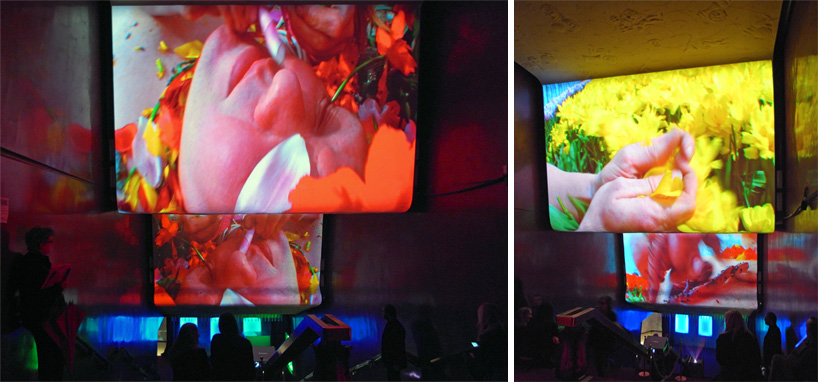
Image from Designboom

The exhibition Parasimpatica by Pipilotti Rist combines some of her old and new work incorporated into the space of the old Manzoni cinema. The viewer is immersed into a psychedelic world of bodies, fruits and liquids. 

In the entrance hall a chandelier of underpants hangs from the roof with a colourful video projected onto it.  As one enters overhead on the stairs, viewers can see a large projection with seductive music. In the foyer one video is shown behind the bar and another next to another staircase. This leads into the auditorium which shows three major video works.  Viewers who visit the restrooms are surprised by small video projections in the toilets.

The work seems to capture a kind of zeitgeist of the images that is an occurring theme in popular culture especially evident on blog platforms such as Tumblr etc; free-spirited nymph-like figures of women, sexuality, youth and nature. Despite of the familiarity of these images, the hallucinatory colours and slightly playful upbeat nature of the work, it still addresses some serious questions about the body, our physicality, and the portrayal of women in pop culture.

The show is seductive, visually stimulating and could risks being too indulgent, but she does succeed to pull one into the works and make you want to understand more.