Showing posts with label Text. Show all posts

Tuesday, November 11, 2014

The "Spectacles" of Public Art.


Last week a public sculpture titled “Perceiving Freedom” was revealed on 6th November in Cape Town, when South Africa celebrated 20 years of democracy; it is meant as a tribute to Nelson Mandela. I learned about this project on Facebook where disgruntled commenters called it out for its shameless use of Mandela’s name and for being a billboard for the brand Ray Ban. It got me thinking about our project we did, and also the "butplug" incident of Paul McCarthy and public art in general.  

Two years ago two friends and I created a work in Milan, a pair of 3 meter long “Ray Ban” style sunglasses made out of cardboard titled “Monument” that we left in a public space to be torn apart by passersby. Our work was born out of a workshop during our studies where we were challenged to come up with a proposal for a public work that took in consideration the collective memory and history of the area where we were based. This was hard for us, as we were three foreigners who have only been living in Milan for a few months. Instead, we chose something; a symbol which we thought encapsulated the Milan of the moment, pink Wayfarer shape sunglasses. Sunglasses for us was the smokescreen of Milan and all its insecurities, all the fashionable people hiding behind their sunglasses and the precarious lives of immigrants selling the fakes on the street (there were a lot pink ones). For us the idea of a monument could never be permanent and our work wasn’t clean and sleek, it was messy, vulnerable and held together with sticky tape and kept up with stilts made out of wooden broomsticks. There were many flaws in our work, we were terribly disorganised. We did not involve the public very much in the initiation of the work, but we included them by allowing them to strip it apart and break down a "Monument". Our sunglasses had a  completely messy appearance which saved from looking like an ad campaign for sunglasses. Now in the light of the new sculpture revealed, I am reflecting on this work again and also the meaning of making in art in public spaces.

I ask myself these questions:
Does the work leave space for interrogation of its context?  Does it acknowledge the vulnerability of public space? Does it consider its public? Does it ask its public to participate and to reflect or does it only offer fashion and consumption, holiday photographs and selfies? 

I found this beautiful reflection by Rebecca Hodes on the new sculpture, I also remembered a text I read years ago by W.J.T Mitchell on the violence of public art.

Thursday, November 15, 2012

I Cani Abbaiano - journal


 Our class created a journal for our one class called Economy of arts under the guidance of journalist Manuela Gandini who regularly contributes to Alfabeta 2 a critical Italian journal focussed on arts,culture and society.The title of the journal translates as The dogs are barking. You can get the actual journal here in pdf but it is in Italian. 


 Here is the editorial that I wrote. 
“An old west African proverb compares the artist to a dog. Positioned at the interface of the
human and the natural worlds, the dog in most ancient African societies enjoyed slippery and
highly ambiguous cultural status.
Neither a human being, nor a wild animal, it was nevertheless admitted in the domestic
sphere where it was recognised as man's best friend.
Loyal to a fault, it was committed to its master to the point of helping him hunt wild animals.
This is why it enjoyed special rights.
Because a dog was never happier than when its nose was up another's rear end- the anus,
that sensory button of the world - it also symbolised debasement and degradation.
Just like the dog, the artist also enjoyed special rights, including the right to conduct
forbidden experiments. His task was to translate society to itself”. – Achille Mbembe, Cape
Times, June 5 2012
The economic crisis has stimulated a range of conversations against the capital and consumer driven
system that the Western world have been comfortably nesting in for years. It has illuminated the
flaws of a system that has dominated and affected the core values of Western society the 21 st
century. It has in fact illuminated us to see that change is necessary, that is also a change in the
values that informs our decisions.

It is from here that we can see why it is necessary to create an enquiry also from the perspective of
the arts. The most obvious reason is that economic crisis’s or government financial policies affect
also the cultural sector. Producers of culture needs financial support and space in order to live, and
produce work.

When analysing the current situation crashing financial markets, greed driven corporations and
speculation are terms that superficially touch on the causes of this crisis. It easy to lay out the
blame on investment bankers, CEO’s and governments, but it did not come over night with a few
evil personas. It is a system of values - a culture - that has been the basis of the production and
consumption that we live in. We are not innocent bystanders or just simply victims of this system;
we were also participants in it. This includes the cultural sector; us as artists, curators and writers.
Thus as cultural workers we need to understand how we fit in to this economy, what systems of
production we use and what we do to change or uphold it.

Starting with a historical analysis allows us to see how we got here. Understanding how the arts
came to reflect the financial system of speculation, understanding the invention of the art market.
This also reflects on systems of power and how it came to be in the hands of a select few. We
look to the economic crisis of the past, the great depression, reflecting how it was dealt with even
sometimes in bazaar ways.

If one can understand the past we can reflect on the current situation. How is art valued today, what
is its role in society and how does political policies and the financing of it affect it. In the globalised
world we can learn from each other and trace similarities. An analysis of different concepts of
financing and public perception in different geographical areas starting from the sophisticated
funding system of Northern Europe to the complications of funding in a developing country; South
Africa. Another analysis shows the political complications affect art in Columbia and the review of
public art policies in Taiwan. We understand that we are not isolated.

A final part looks at how it has come to this, how the world has been perceived theoretically and
philosophically and how artist imagine and approach the situations. One might argue against or an
autonomous group of artists occupying and appropriating corporate buildings and urban spaces, or
Utopic imagined spaces as unrealistic, but it serves as mirrors held up to imagine what can be, or
what should not be.

One might ask why it is important that we as cultural workers publish a volume of articles on art
and the economy. The answer is this, we are the dogs, we need to dig up the old bones, we need to
start barking at the gates to warn of the thieves that enter to prevent them from stealing the good
ideals of society. We are not wild animals outside of the house; we are part of it and will contribute
to improving it.


Tuesday, May 22, 2012

Art and Violence: "The Spear"


The painting The Spear by Brett Murray has by now aroused such interest and reaction negative and positive that it has taken on a form beyond itself, an image which became the symbol and space for all to use for their motives of expression. From the original intent of satirising government and the president to a method of reinforcing racial clashes, discussions of freedom of speech to discussions of what is the role of art or what is art, as well as a well written post-colonial critique I would recommend.

I can’t help but think that as a painting, an isolated object of art it is rather simple (aesthetically, I mean, that poster aesthetic is kind of what a lot of people do, there is is even that function on Photoshop) and  as  political satire goes, quite superficial. An artist doesn’t have to work hard when using a figure who already carries all the weight of meaning on itself. The power of this artwork lies within its context and the debates it aroused.  And I would like to also argue that the defacement of it (although I really do not wish the gallery or artist any harm), would be the ultimate act to complete it.  

W.J.T Mitchell comes to mind in his discussions of iconology and iconoclasm.  Both the artist and the defacers used an iconoclastic gesture. Both acts could be considered violent. The artist using subversion breaks down the untouchable image of the president by showing us his genitalia.  It is a violent act to expose someone, it is a violating act. And some might argue, yes but he is a bad president, he inspired it, but one must also say, yes but he is also human, and can still be hurt, he can still be violated. This gesture in some way reveals this contradiction. 

Then there are the defacers. Physically painting over the image which angers, the wish to destroy it, to cover it is violent, the word deface itself indicates this violence. Usually objects displayed in a gallery on the wall remains untouchable, they are holy objects to be admired, to be contemplated, to be sold, but never to be touched. That final act of defacement was a violent one, and rebellious against the system of the gallery. The covering up of the painting with a red crosses and then with black paint reveals just as much as that of the original.

Both works revealed this relationship with violence we have in South Africa. We use it for a motif as we criticize it, we us one form of violence to satirise the president, another form to counteract it.  It was also revealed on blogs and Facebook in the commentary by readers and viewers as this soon became the way for people to personally attack each other’s view.  We like to complain in South Africa about the crime and violence, but I dare to say that our attitudes of distrust and defence lies right in the middle of our problem. Or perhaps this is the result of it. 

Another topic arouse through this work was that of censorship and freedom of speech. The president wanted them to take the painting down. The gallery refused, stating it will not succumb to censorship. People advocating that it was freedom of speech, the right of the artist, congratulated the gallery for standing up for freedom, while others criticised saying that this disrespect of the president must not be stood for. Of course censorship is a slippery slope and for sure a president must not be allowed to censor artworks, if one can start, before one knows it, anything that defies the president can be shut down and then we have a problem. Yet the defacement of this painting revealed the complexities of freedom of speech and its relationship to who holds the power.  Some of the same advocates that hailed the painting as the right to expression of the artist found this defacement  a crime, and from a video I saw the culprits were arrested and quite violently so too. Yet weren’t these defacers not just using their freedom of expression?

Defacing a painting is an atrocity someone said on Facebook. Why would such an act be considered more violent to some than the (albeit visual) personal attack on the president – a human being? The ultimate was revealed when they started speaking about the monetary value of the work, how this cost the gallery and the artist R 100 000 (or something like that). We all know the art market is based on speculation, this is not the true worth of the painting, yet many of those same advocates of freedom of expression considered this an important enough reason to justify that the defacers freedom of expression was in fact illegal, that its monetary value excludes it from the fire.  The ultimate question lies within this, what are the limits of freedom of expression or more specifically, who has the right to freedom to expression? Those who have ownership? Another question arises, when does something pass as hate speech, one wonders don’t haters also have a right to expression (the twitter model debacle comes to mind)?

These questions cannot easily be answered and should never result in censorship. Yet we must ask ourselves what responsibility we carry in our right to expression, what violence do I carry in my right to expression? So in the end I must wonder about the brilliance of this painting as it revealed so much more then the short comings of our president and the ruling party, but also so very much about our own hypocrisies.  

Friday, April 27, 2012

A picnic: Progress and Development (2012)

(image from the 2009 BBC TV-mini series Emma)
The picnic- this romantic idea of eating together, a social gathering in nature -  was used in 19th century English novels as a literary space for  romantic gestures, revealing social inadequacies and personal revelations (Emma by Jane Austen comes to mind). The picnic then could also serve for the perfect space to reveal our own desires and inadequacies.   In the absence of nature the action of a picnic remains the same, everyone can bring something, to sit down outside, with the the basket, the blanket and the food, yet it might almost seem sad. Though at the same time plotting down a space in the city, sitting down on the sidewalk on the cement becomes a defiant action against the movement, the progress that the capitalistic city promotes. 

I would like to invite all to join my picnic on 6 May from 11:00 am onwards in Isola, Milan at the parking lot in Via Pepe. It forms part of the intervention IN SU I PRÀA(which means on the grass in Milanese dialect) which is a project of our class collective Room 47. It will be intertwined with the activities of the festival  of Isola Pepe Verde. Find my three picnic spots around the space and you are welcome to take seat and eat the contents of the baskets.
  -------------------------------------------------------------------------------------------------------
Il picnic – questa idea romantica di mangiare insieme, incontrarsi in natura -  nella narrativa inglese del 19° secolo era utilizzata come spazio letterario per gesti romantici, analisi delle carenze sociali e rivelazioni personali (come Emma di Jane Austen). Il picnic, anche oggi, può essere  lo spazio ideale per mettere in mostra i nostri desideri, le nostre carenze. In assenza della natura l’azione di fare un picnic, con i suoi riti e gesti stereotipati, potrebbe quasi sembrare triste. Tuttavia l’azione di prendere possesso di un spazio nella città, sedersi sul marciapiedi, stazionare ai bordi della strada, può diventare un azione provocatoria contro la frenesia , lo sviluppo che la città capitalista promuove.

Vorrei invitarvi a un picnic 6 maggio da 11:00 la mattina nel parcheggio di Via Pepe, Isola, Milano. L’intervento fa parte del progetto IN SU I PRÀA(dialetto milanese per in sui prato) di nostro colletivo Room 47. Sara parte della festa di Isola Pepe Verde. Il mio intervento consiste di 3 picnic che si svolgeranno durante la festa. Le Coperte indicheranno gli spazi dove le persone sono invitate ad interagire.


Sunday, March 18, 2012

The value of art


While doing research for the text I have to write for my subject Economy of arts, I came across this really great interview with Achille Mbembe a theorist living in Johannesburg. He discusses the problem with art funding in South Africa, and addresses some issues also about funding coming from the Western world to Africa and the traps of thinking so narrowly about the value of culture. Go read it here.
"We have to realize that culture is not yet another form of “service delivery”. It is the way human beings imagine and engage their own futures. Without this dimension of futurity and imagination, we can hardly write a name we can call ours or articulate a voice we can recognize as our own". 
"We need to move away from this form of crass materialism and this empiricism of wants and needs in order to rehabilitate cultural and artistic critique as a public good in and of itself. The value of art cannot solely be measured on the basis of its contribution to material well-being. Nor is artistic creativity a luxury or an immoral pursuit that should be redeemed by its annexation and inscription in the official, state-sanctioned discourse of development and poverty reduction. We must resist this trivialization.
 Artistic creativity, cultural and theoretical critique is an integral part of the immaterial and unquantifiable assets produced by a society. It is a constitutive dimension of our communities and nations wealth in the same way as our physical infrastructures. It’s value by far exceeds the means by which this value is counted. The management and regulation of art and culture should therefore pertain to a different order, one that takes seriously the “intangible” and “inalienable” qualities of culture and one that, as a result, is not dependent on purely quantitative measurements and indexes".Achille Mbembe. 
And you can read a constructive response to this by Pamela Allara , I tend to agree more with  Achille in a sense that I feel that often in South Africa, getting funding is directly related to it having some social activist role, or having to fit into the role of producing art reflecting on  Apartheid or ethnic identity.  

Monday, March 5, 2012

Antropologia Visuale: Experimental blog

For one of my subjects called Visual Anthropology we discussed concepts such as iconology and iconoclasm. Based on ideas of Bruno Latour, W.J.T Mitchell, Regis Debray it was quite a challenging and stimulating class. For the exam we could then develop arguments around these themes. I created a presentation on Tumblr, to explore the concept of iconoclasm within the contemporary art scened fot he 1980's to the end of the 1990's in South Africa. The Tumblr is supposed to be like a mini exhibition which summarised the main points and shows some artworks. Of course it is not all comprehensive, so probably miss a lot of things. 
 Another thing that I am not completely satisfied with is the actual design of the presentation, but I 've been trying to find the right theme that doesn't cost an arm and a leg, that gives an exhibition feel. I am still in the dark on editing the codes so that I can actually reset the column widths and for example change the way it squeezes the pictures, it is just so time consuming to try and read trough the codes.  See the actual blog here.


Sunday, March 4, 2012

Exhibition review: Pipilotti Rist


Here is an exhibition review that I wrote a while back for our class in writing, I thought it would be good to post it here. I have to say that I loved the exhibition.

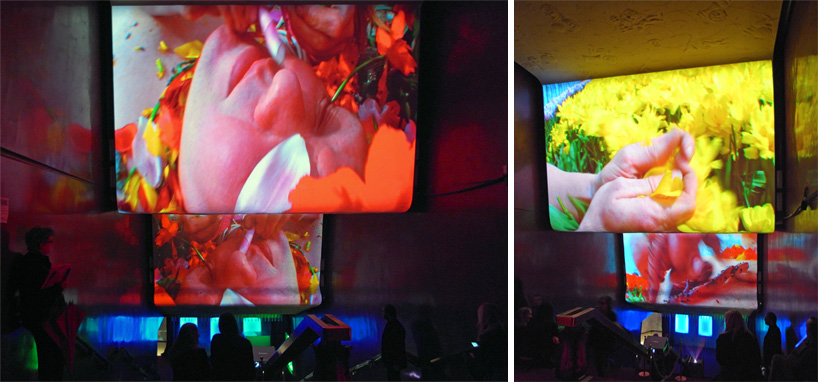
Image from Designboom

The exhibition Parasimpatica by Pipilotti Rist combines some of her old and new work incorporated into the space of the old Manzoni cinema. The viewer is immersed into a psychedelic world of bodies, fruits and liquids. 

In the entrance hall a chandelier of underpants hangs from the roof with a colourful video projected onto it.  As one enters overhead on the stairs, viewers can see a large projection with seductive music. In the foyer one video is shown behind the bar and another next to another staircase. This leads into the auditorium which shows three major video works.  Viewers who visit the restrooms are surprised by small video projections in the toilets.

The work seems to capture a kind of zeitgeist of the images that is an occurring theme in popular culture especially evident on blog platforms such as Tumblr etc; free-spirited nymph-like figures of women, sexuality, youth and nature. Despite of the familiarity of these images, the hallucinatory colours and slightly playful upbeat nature of the work, it still addresses some serious questions about the body, our physicality, and the portrayal of women in pop culture.

The show is seductive, visually stimulating and could risks being too indulgent, but she does succeed to pull one into the works and make you want to understand more.